
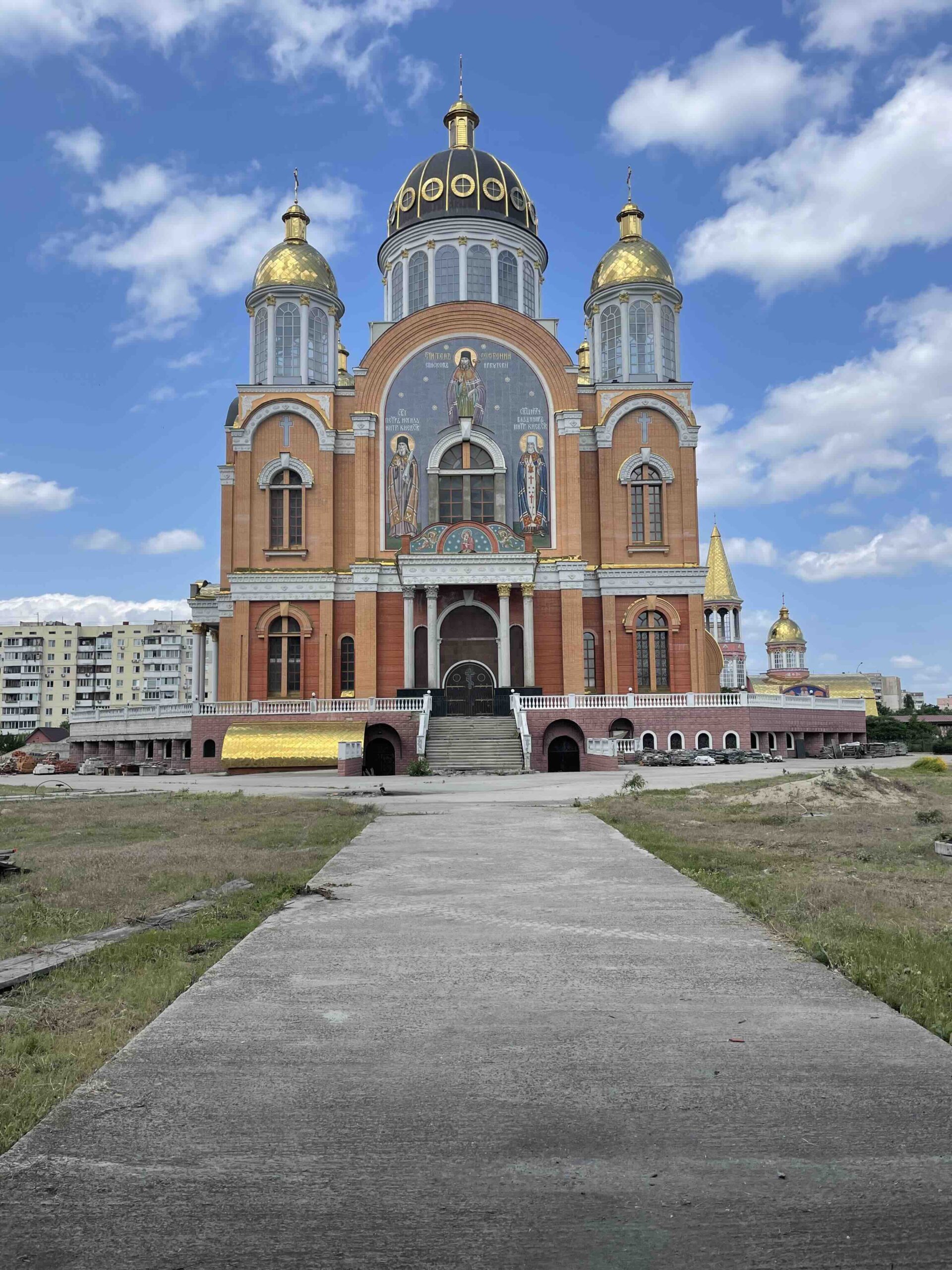
Another amazing cathedral near the Dnipro River in Kyiv.
Monday June 9
The household started the day slowly due to the disruption of the drone attacks in the night. I had nothing on my personal agenda and everyone in the household was busy for the day. So, with another date with Valerii Pekar set for 5pm I was left to my own devices. I spent time journaling about th weekend, then went for a lovely and extended walk.
I passed another amazing cathedral, this one smaller, but still ornate with golden domes and huge figures of saints painted in great detail. I visited a grocery with a cash machine. I stopped at a little run-down marina and rested at a deserted table in what had once been a café. Surprise: before long, a listless waitress came out to get my order. I got a lemonade, which would have been better cold. I asked for ice but they had none. Noneleless I sipped my drink and sent a few texts back home.
Then, off to meet Valerii again. This time he took me to the Parliament building and the Presidential Palace – which, he explained, is not an actual residence but a place for ceremonial functions. Both buildings are closed to the public due to the war.
We spoke about President Zelenskyy. Val observed that the Ukrainian president is popular and even cherished as a national leader, with 80% popular support. He became a stronger leader, in Valerii’s view, by having to lead the country through the full-scale invasion. Yet he is not well-liked as a politician. Though Zelenskyy is appreciated for coherent and effective leadership, he may not be re-elected once the war ends. This points to both loyalty and discernment in the Ukrainian electorate, which I’m unsure America’s could match.
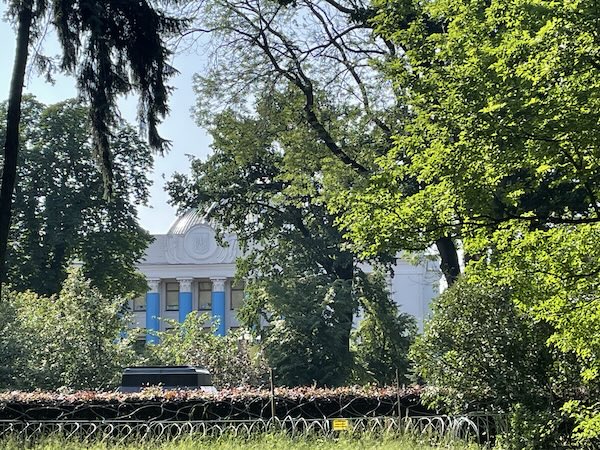
Ukraine’s Parliament Building is fenced off due to wartime.
The doric columns of the Ukrainian Parliament building are painted blue and yellow for solidarity due to the war, and a transparent dome arches over the meeting hall where legislation takes place. Parliament is not suspended, as I’d guessed, but continues to meet, handling the policymaking and oversight of the country. Of 450 seats – matching those in the US House – only about 400 are occupied, since some war-impacted regions cannot send representatives, and due to attrition since Ukraine suspends elections during wartime.
Valerii explained that Parliament is operating under a single majority party; he considers this less desirable than a coalition since the latter requires overt negotiation. He described the three major parties: The majority party of Zelenskyy is the Servant of the People Party. The opposition conservative party is the European Solidarity Party, led by Poroshenko, Ukraine’s president after the Revolution of Dignity deposed Yanukovich in 2014. The liberal party is the Motherland Party, led by Tymoshenko, a former prime minister. Valerii prefers another minority party, the Voice Party, because of their support for entrepreneurship. He emphasized that “conservative,” “liberal,” and “populist” vary widely in meaning from country to country.
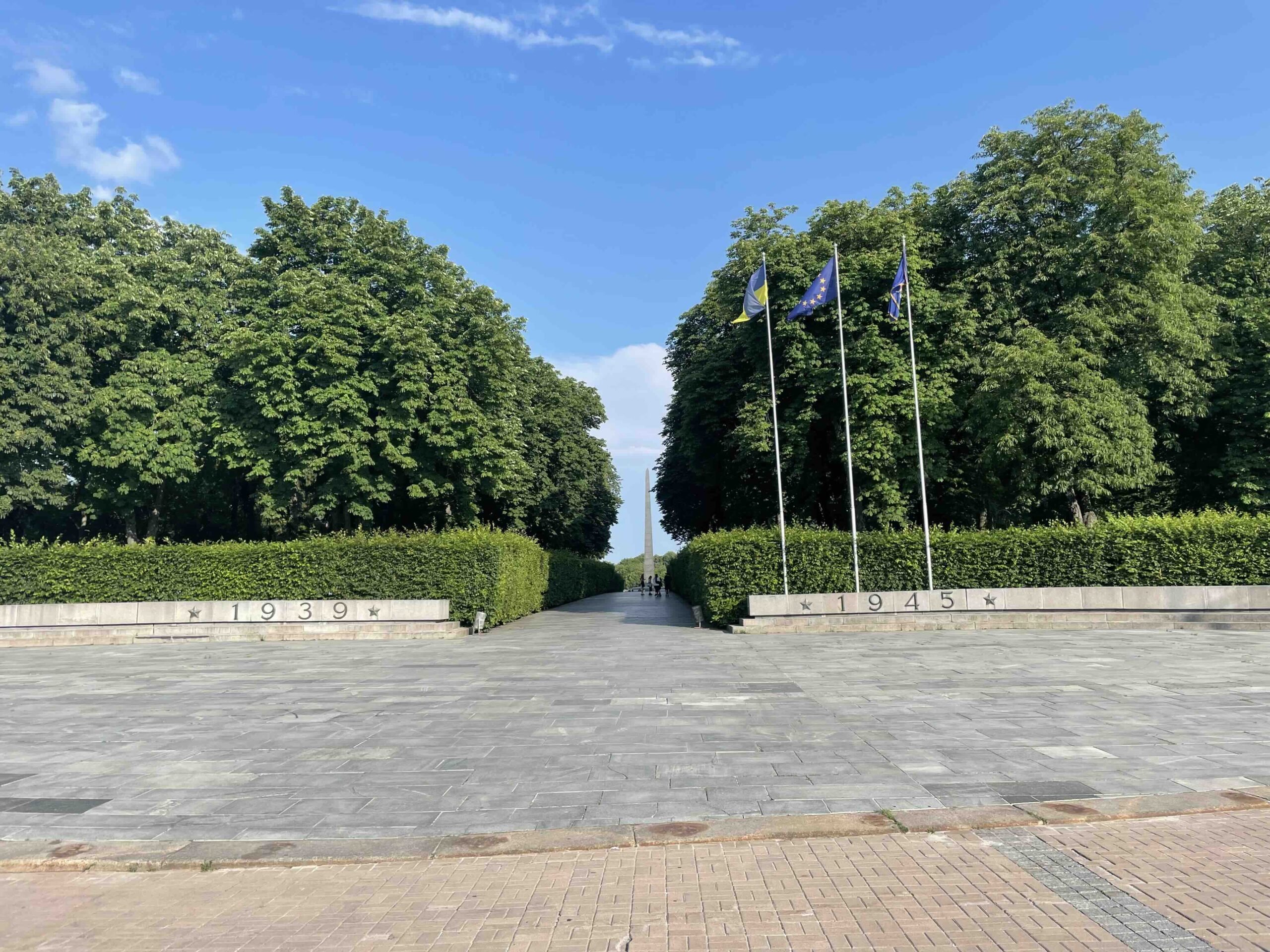
The amended dates on this memorial are a story in themselves
We walked to a plaza memorializing the fallen of WWII with a date inscription of 1939-1945. These numbers were recently corrected, Val explained. First carved in the Soviet era, the memorial originally read 1941-1945. Those dates reflect the fact that Russia was aligned with Nazis from 1939 until 1941. Once they became Nazi victims instead of collaborators, Russians marked the start of the war. Thus the original dates sanitized Russia’s culpability in the origins of WWII.
Next we visited a bluff where two monuments overlooked the city. The first was an obelisk with a permanent flame at its base honoring Russian soldiers who died in WWII. Why does this monument still stand, with Russia-Ukraine relations at such a low? Because in WWII, Valerii explained, Ukraine was a hero and Ukraine was a victim. Since Ukraine was part of the USSR at the time, perhaps 1/3 of Russian soldiers were actually Ukrainian. Thus they continue to be memorialized here. Also, with Ukraine much closer to the Nazi front, Ukraine (along with Belarus) was a battleground; and other Russian territories were minimally impacted by the war.
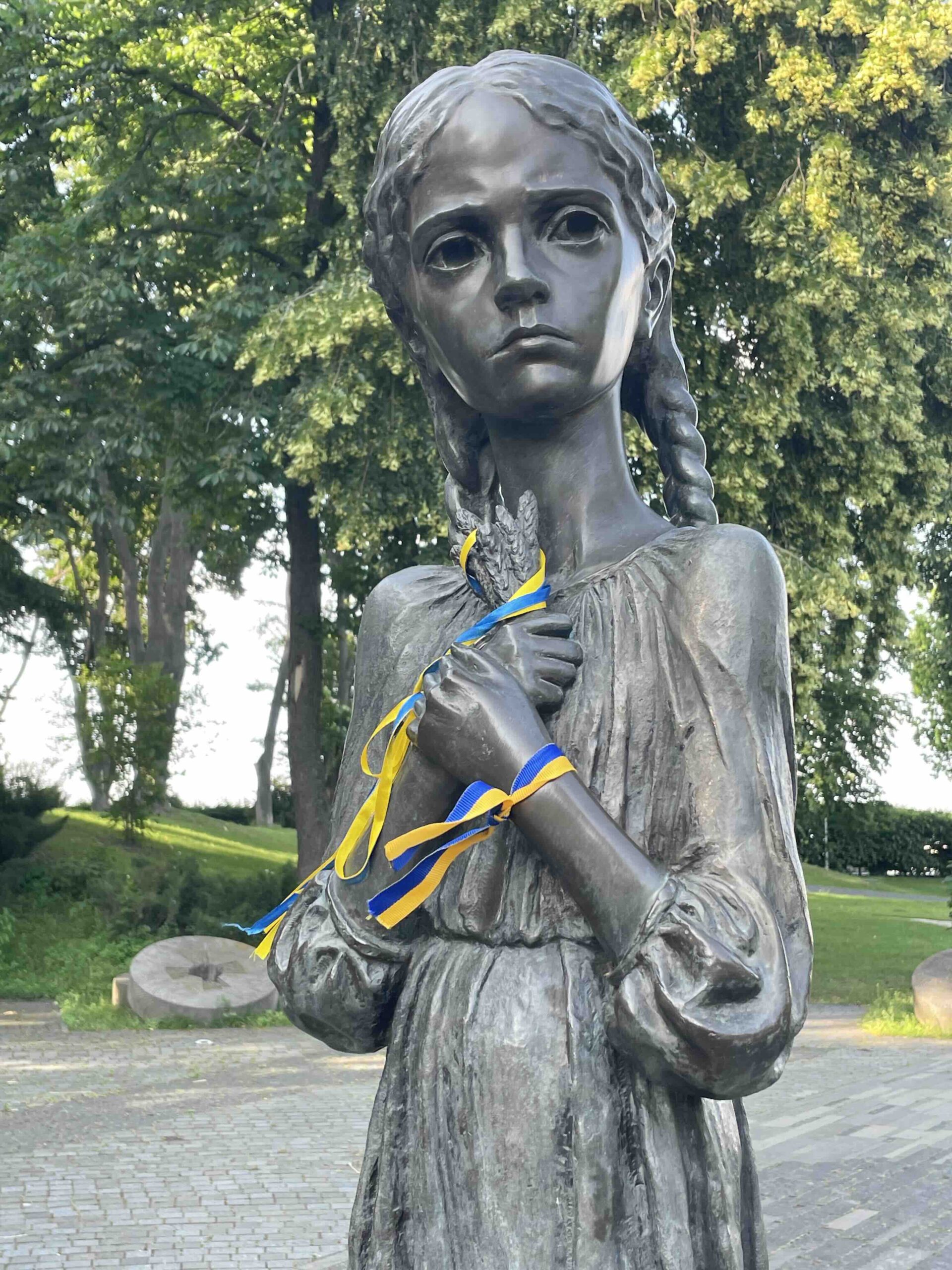
This image honoring victims of the Holodomyr touched me deeply.
The second monument we visited truly moved me: It memorialized those who died from the Holodymor, the famine of 1932-33. The monument was accompanied by an image of a starving girl so evocative it moved me to tears. Someone had tied blue and yellow ribbons around the girl’s wrists, as if to remind viewers that Russian oppression of Ukraine continues.
Spending time with Valerii Pekar left me both elated and exhausted. This humble man is a lecturer at four universities in two cities, the author of over 500 articles and two books, yet is very kind and warm. We walked and talked for hours, visiting places of historical and architectural note, weaving stories from the past thousand years into observations of the current day. Fascinating is almost too dry a term for this experience.
I asked Valerii about the term Cossack, specifically wondering where the Cossacks were from. I had gotten confused with the parallel between “Cossack” and Kazakh.” He clarified that although the etymology is similar (derived from a term for “free man”) the Cossacks and Kazakhs are unrelated. Cossacks didn’t come from anywhere; they were the original people of the land we now call Ukraine. Cossacks founded many things in Kyiv, including the first university in the country.
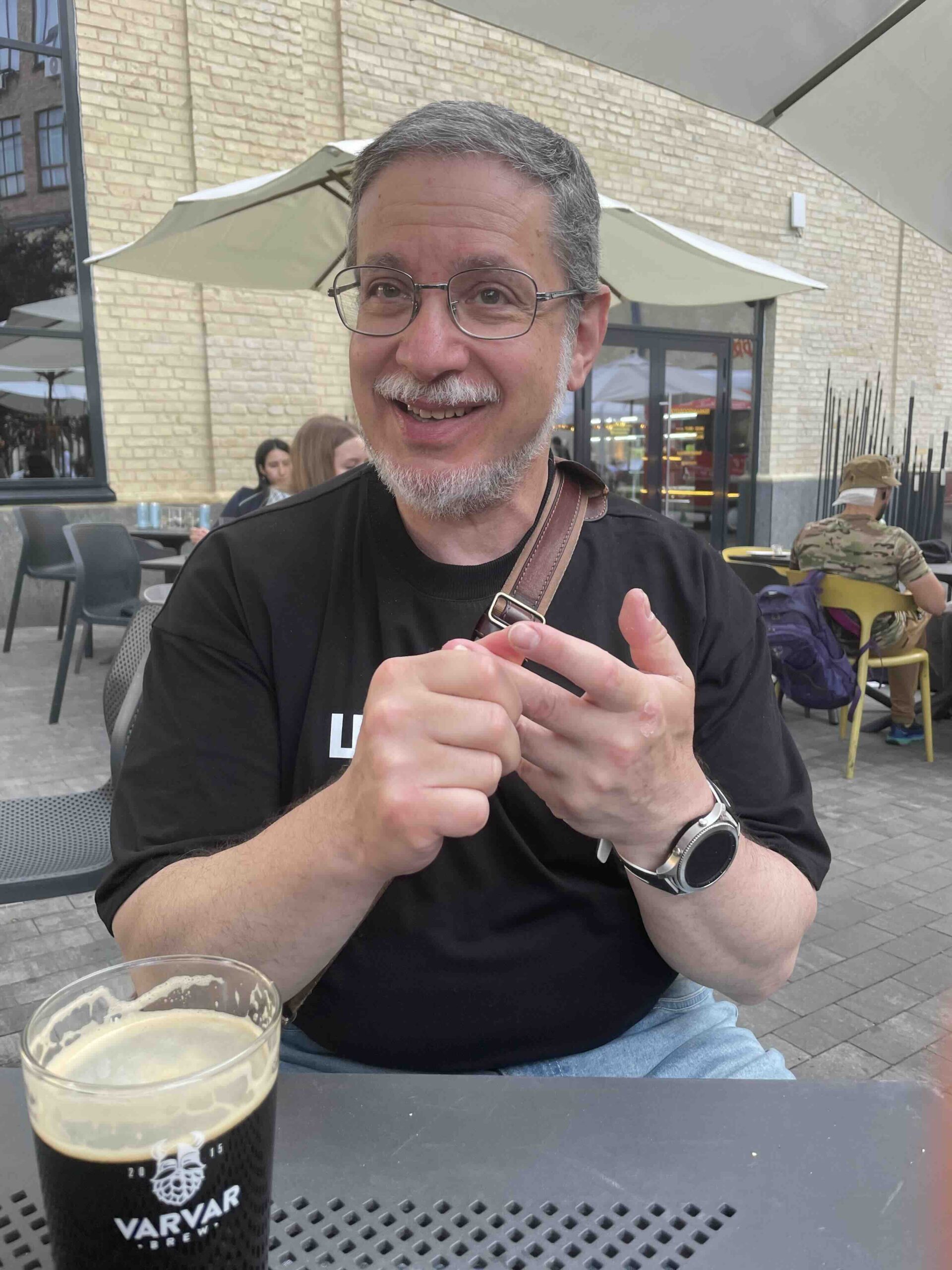
Learning from Valerii Pekar was a key part of my Ukraine experience.
Sitting at a brew pub with Val at the end of our day, I felt both immersed in a 400-level crash course in Ukrainian history… and at the same time, felt like I was hanging out with a new friend sharing his enthusiasm and knowledge. It seemed that I wandered into an oasis in wherein complexity and integral perspectives are accepted norms. And I felt humbled by the privilege of spending two large chunks of time with a leading Ukrainian intellectual. Knowing that responsibility comes with knowledge, how can I act in a way commensurate with the tremendous honor I have been given?
I keep using the word surreal to characterize this experience. It’s reminiscent of my time at the Integral European Conference, in that I’m savoring contact with international thought leaders. But unlike at IEC, I have a visceral sense of being an observer – and perhaps participant –in the making of history. This ain’t no lab course. This is the real world, up close and personal. Sheltering from Russia’s midnight drone attacks, engaging in dialog about Democracy 2.0 in Kyiv traffic, and discussing integral responses to imperialism with Val, I’m awash not just in ideas but in the urgency of acting upon these ideas in our troubled and tumultuous world.
Increasingly I’m encountering in person thought leaders I’ve been following for inspiration, vision, and context. Tomas Bjorkman. Valerii Pekar. Elke Fein. Robert Kegan. Diane Hamilton. Karen O’Brien. Layman Pascal. Kateryna Yasko. The intellect and wisdom of these people have allowed me to approach an agentic relationship with the metacrisis. Looking around at this circle I’m humbled and awed, but also inspired to action.
So what is my role to be in all this? That remains to be seen… but I’m coming into a place that inevitably will entail more study, more connection with the above leaders, and more responsibility in passing along the understandings and discoveries that I have to offer.
Tuesday June 10
On my last full day in Kyiv, the question of why I’m here and whether I got what I came for resurfaced.
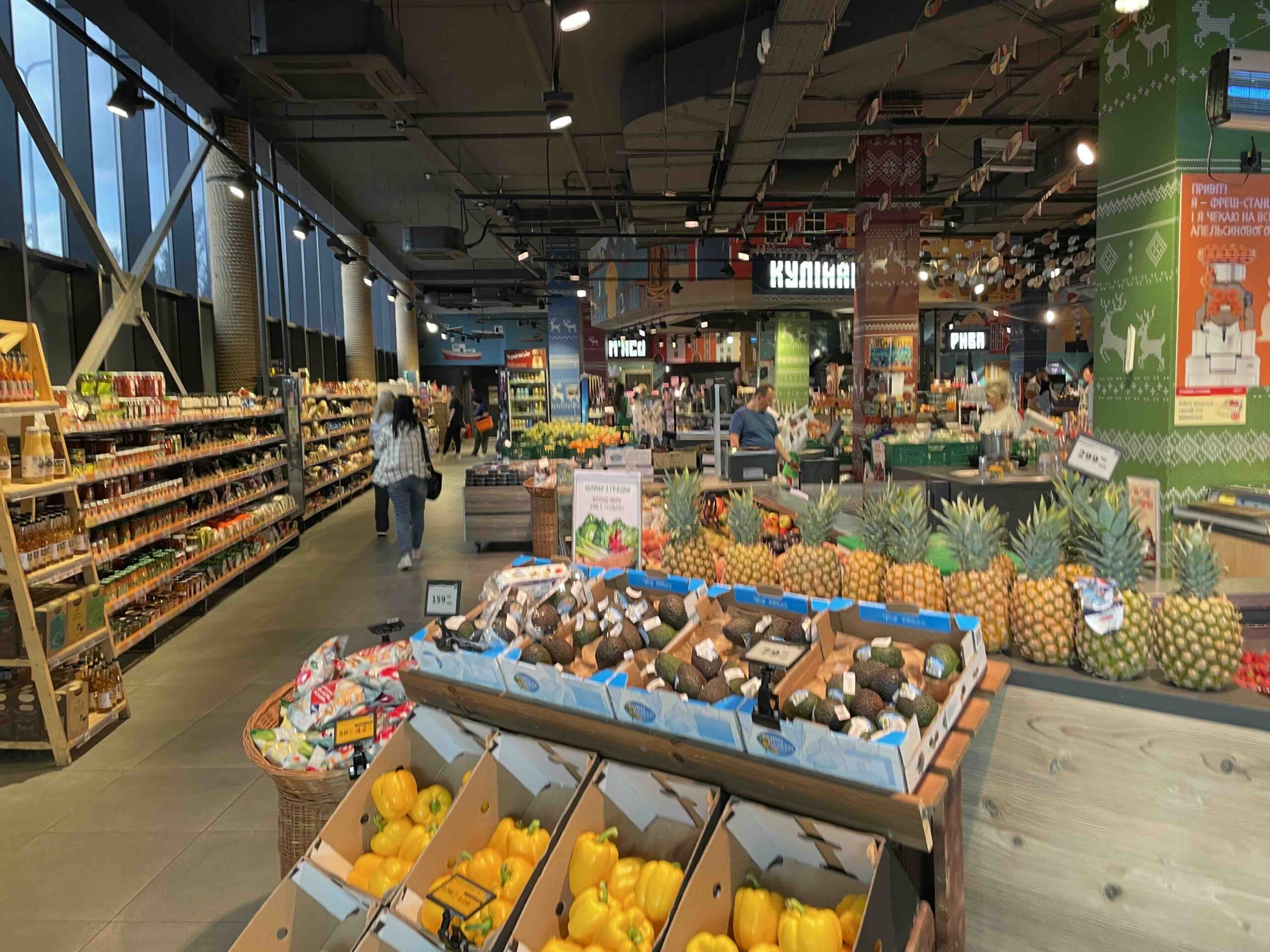
I stumbled upon a first-rate grocery reminiscent of stores back home.
I spent time walking around the city on my own, reflecting on the richness and impact of my time with these beautiful people in this beautiful place. After buying food for my trip and getting cash for my train tickets, I got my reading glasses fixed by a friendly lady at a tiny little optical shop. Yet again, I made a connection across a language and cultural chasm, bridging the gap with kindness and mutual interest. It’s hard not to see the essential unity of humanity when it’s so easy to connect across difference.
It’s taken me a while to make my peace with the lofty sound of the term citizen diplomacy. I’ve not met with any ministers or generated any policy platforms. But I am here building solidarity with the Ukrainian people, and to seek ways to be a strong ally to this cause.
Wandering the streets of Kyiv I felt that solidarity. All of us walking these streets – whatever our roles, our native languages, our values – were awakened by the same ominous whining of drones, the same tooth-rattling explosions in the middle of the night. And yet here we all are, going about our business, carrying on with dignity and resolve. At a time of mutual survival, a collective forgiveness seems to be in play.
If I could encapsulate just a trace of this experience and share it with Americans more focused on their consumer lifestyles than geopolitics, I might be doing the world a service.
I’ve come to think of citizen diplomacy as the practice of cultivating a global community. As I have written elsewhere, the emphasis here is the word ‘practice.’ This is about more than talk. I had to physically encounter Ukrainian resolve, pride, and autonomy to affirm these qualities in my own sphere of agency.
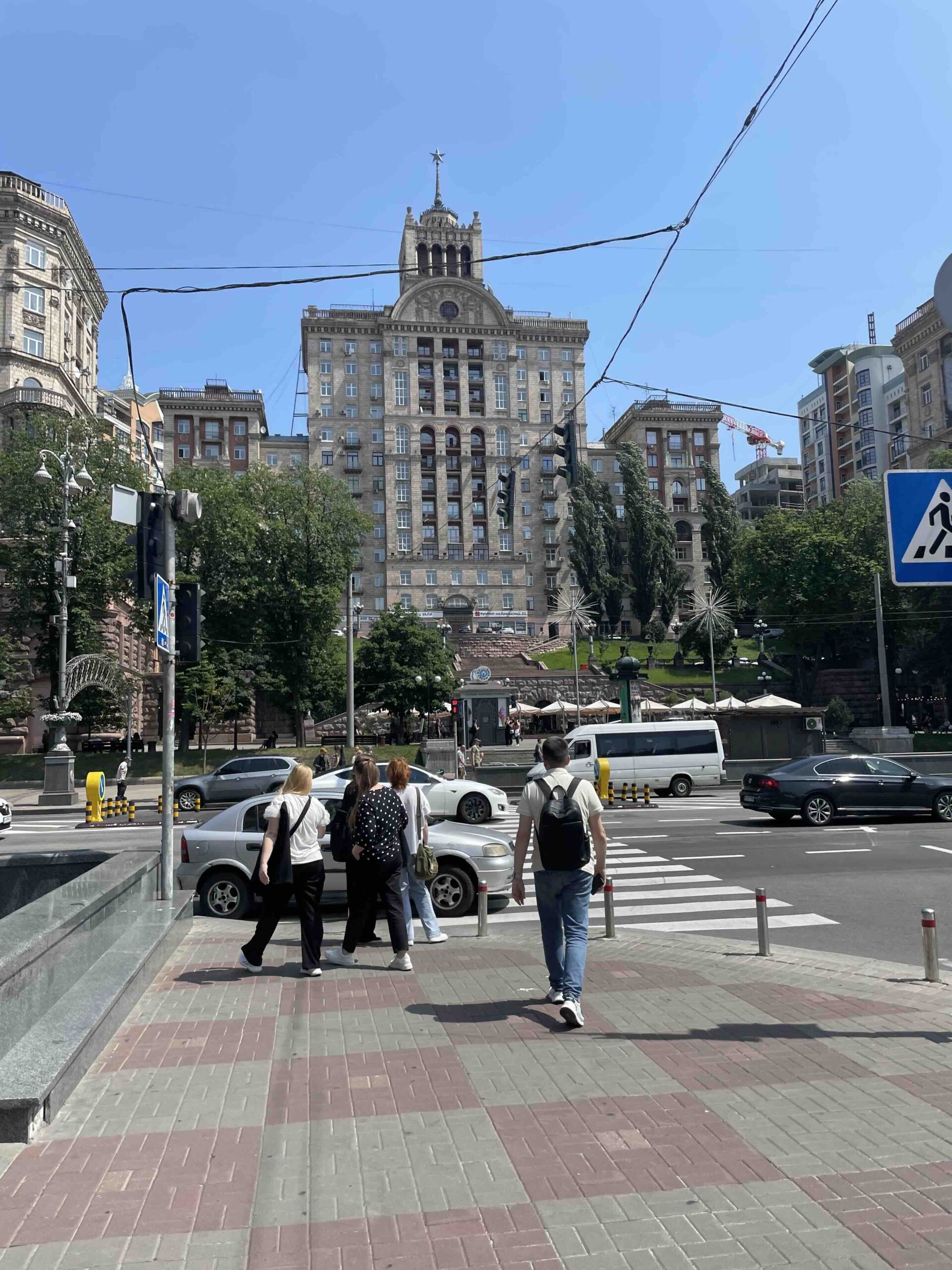
The pleasant streets of Kyiv don’t say much about the war.
In the opening essay of this series, I included a passage written this day:
So why travel to a war zone? It isn’t about the war. It’s about opening to the fullness of the Ukrainian experience. Russia’s aggression does not define Ukraine, nor does Ukraine’s courageous response to that aggression. Ukraine is rich in history, arts, architecture, natural systems, communities, and human services that have little to do with the invasion. But to taste these wonders, and to find joy and warmth in my relationships with people here, necessarily entails acknowledging the war, and perhaps requires sleepless nights of listening to explosions and sirens. I begin my journey home carrying the richness of this culture and these people… and alongside the beauty, traces of terror.
What being an ally to Ukraine actually means is still unclear to me. I don’t inflate my importance or pretend that I can effect major change. But I reject the idea that any of us are powerless. That myth serves only destructive ends. We as humans can do better. With the turmoil in the world increasing, we must do better. I am proud to join those committed to defining what that means — and acting upon it.
In the afternoon I was interviewed on video by Katya’s journalist friend Natalya. This interview was intended for a film to help launch a program for foreigners who want to visit Ukraine. Currently, this initiative is on pause due to other more urgent projects. I will try to post the interview in the “media” section of my website if anyone is interested. I found that the interview helped me reflect on my Ukraine experience, thus informing this essay series.
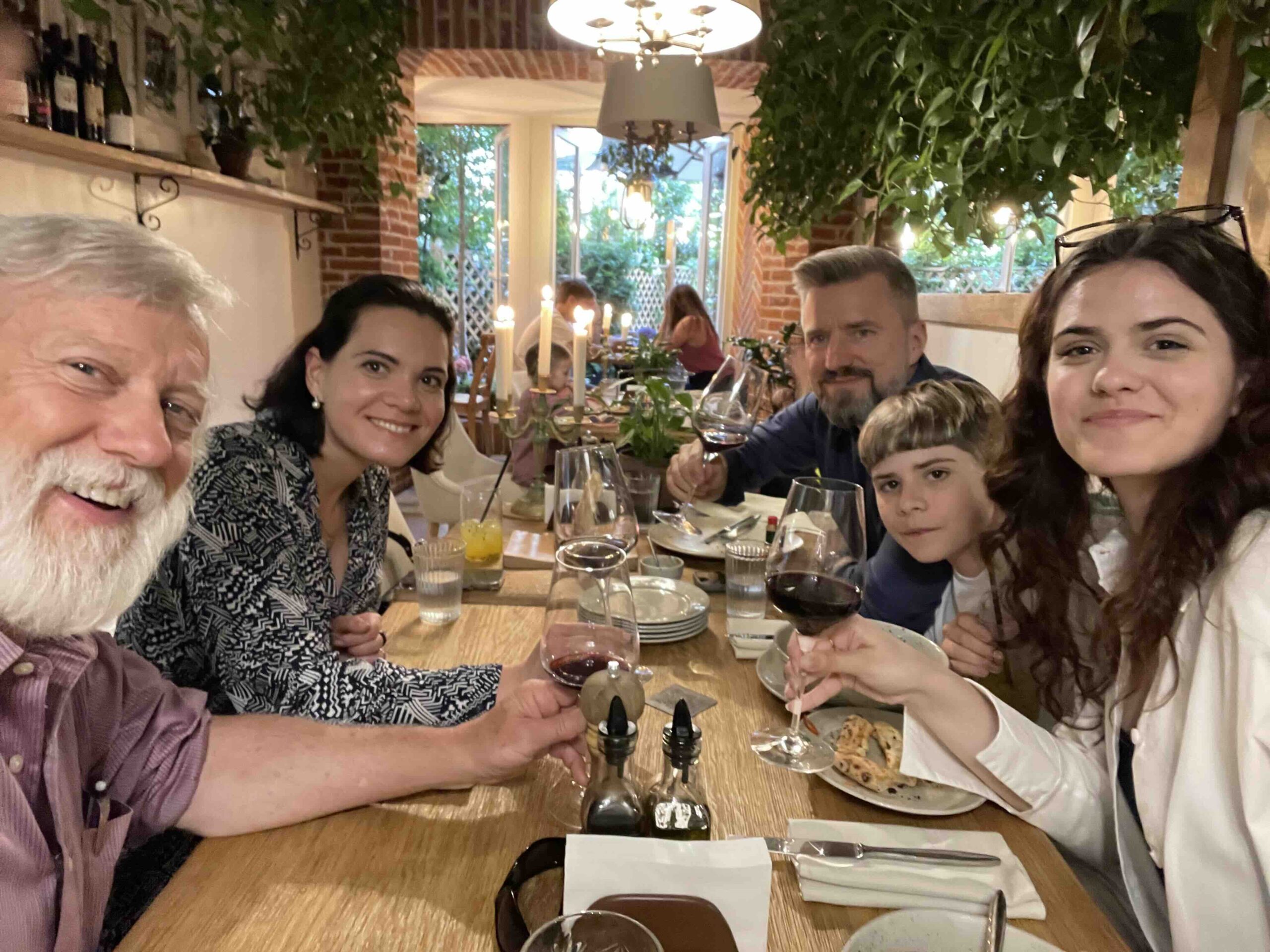
We enjoyed a lovely farewell dinner at a restaurant with the name of 8/8.
My last evening in Kyiv featured two very enjoyable parts. First, I walked in the beautiful park along the Dnipro River with Anya, Katya & Vytas’ daughter. She’s not quite 18 but has remarkable poise, perspective, and intellect for someone her age. Having worked with hundreds of youth over the years, I could tell she was self-possessed to an unusual degree. We had a lovely and complex conversation.
Then, we met the rest of the family for a nice dinner at the family’s favorite restaurant, a place with the curious name 8/8. I thought it reflected a top-tier rating, as in 10 out of 10. But it turns out that the place occupies the eighth sector of the eighth building in a large complex.
The food and service were excellent. We had a glass of wine to highlight our appreciation for each other and the pleasure of having had time together. I felt a bit bad that Petras, their 11 year old, was tired from a long day in school and was often left out of the adult conversation. But to a degree that was inevitable; though I tried to loop him in, it was work for him to engage with us in English. (And his sphere of interests centers on basketball!) Anyway, it was a relaxed, extended meal in which we just chatted at leisure and length, celebrating a simple camaraderie and a friendship that rendered our cultural differences immaterial.
Wednesday 11 June
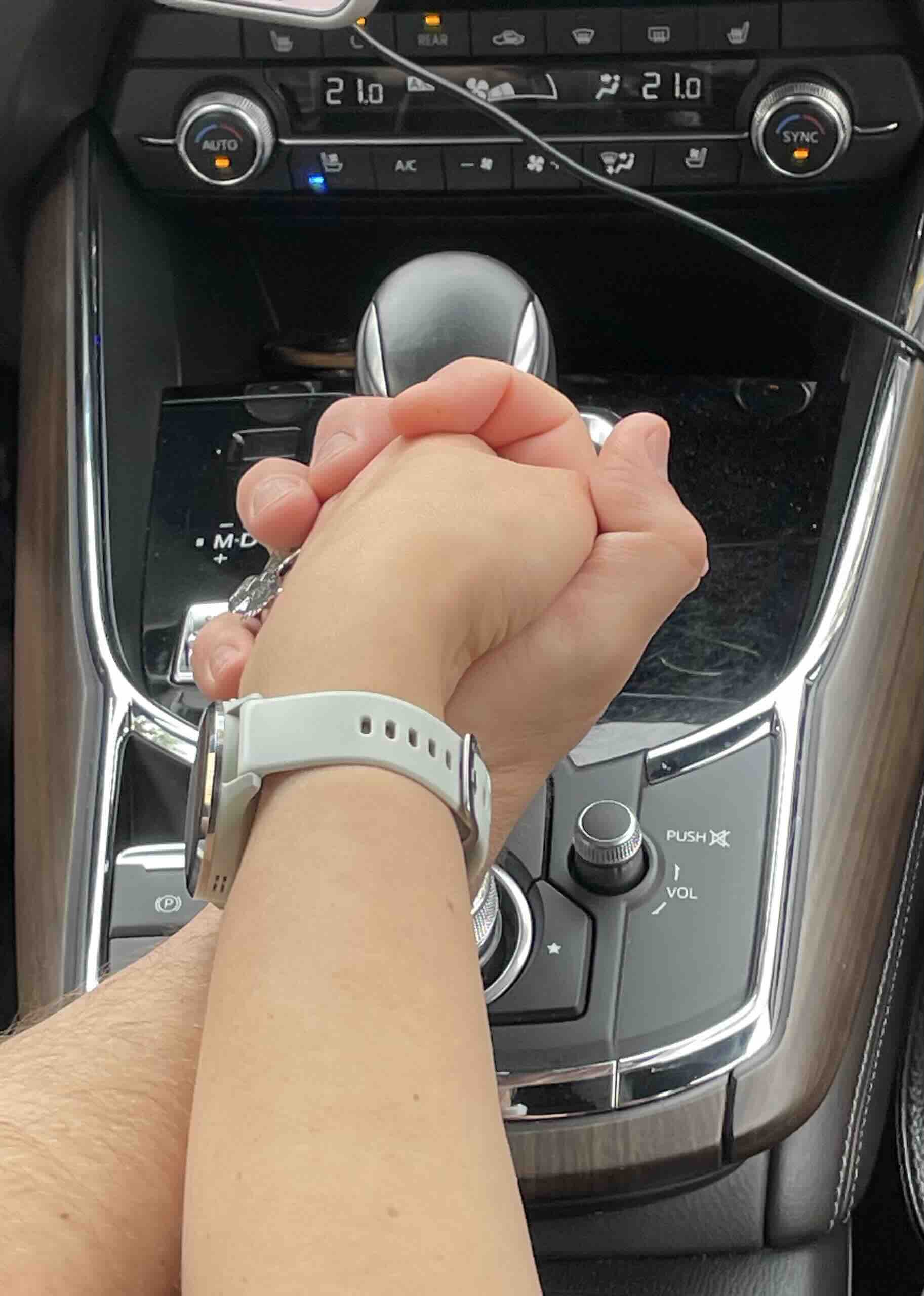
One of my final images of Katya and Vytas
On my final morning Vytas and Katya took me to the train station. There, they insisted on buying me a souvenir (a ball cap with a small Ukrainian flag logo) and one for Lisa (a photo book of Kyiv from the aerial perspective). They helped me carry my stuff onto the train, and after a fond farewell, we parted.
Not long after the train rolled out of Kyiv I fell asleep for two hours. Got up, wrote for a bit, ate lunch, and slept again. The exhaustion that had been with me throughout finally caught up! The train ride also afforded a chance to communicate with family and others, while savoring the waning hours of this colossal adventure.
I felt relief to be on my way home. But I knew I was carrying a weight home with me. The many things I saw and experienced in Ukraine are not like books to be put on a shelf. They represent promises made or debts unpaid: One cannot in good conscience witness Ukraine without being motivated to pursue peace, justice and healing.
It felt good to witness the Ukrainian countryside again, this time in parting. One thing that struck me about Ukraine is its cleanliness. I realized I needed to mention it when I saw a woman, out in the middle of nowhere, picking up litter. A clean countryside may seem insignificant amidst a time of war, ecological crisis, and the spread of artificial intelligence. But it speaks to the dignity of these people, which is central to their profound success at repelling Russian attacks, and to living full and positive lives despite the obvious hardships they face.
The train entered the Karpathian Mountains heading south from Lviv, toward the Hungarian border and the airplane that will take me first to Amsterdam, and then on to Vancouver. The future of how this amazing experience plays out in my advocacy for Ukraine has yet to be lived.
I tried to sleep on the plane. But the combination of daylight, geographic displacement, and stir craziness just kept me awake. So it goes. My trip ran like this: 9am Wednesday to 9pm Thursday equals 36 hours. Add a ten hour time differential to get 46 hours of travel. No wonder sleep was elusive; I was completely overwhelmed from travel and from having written over 12 thousand words in the past week. But that just points to the vast amount of new input I encountered. It was both intellectual – thanks, Valerii, Katya, and Vitas; and psychosocial – thanks, nighttime drone attacks, awe inspiring cathedrals, and dancing babushkas.
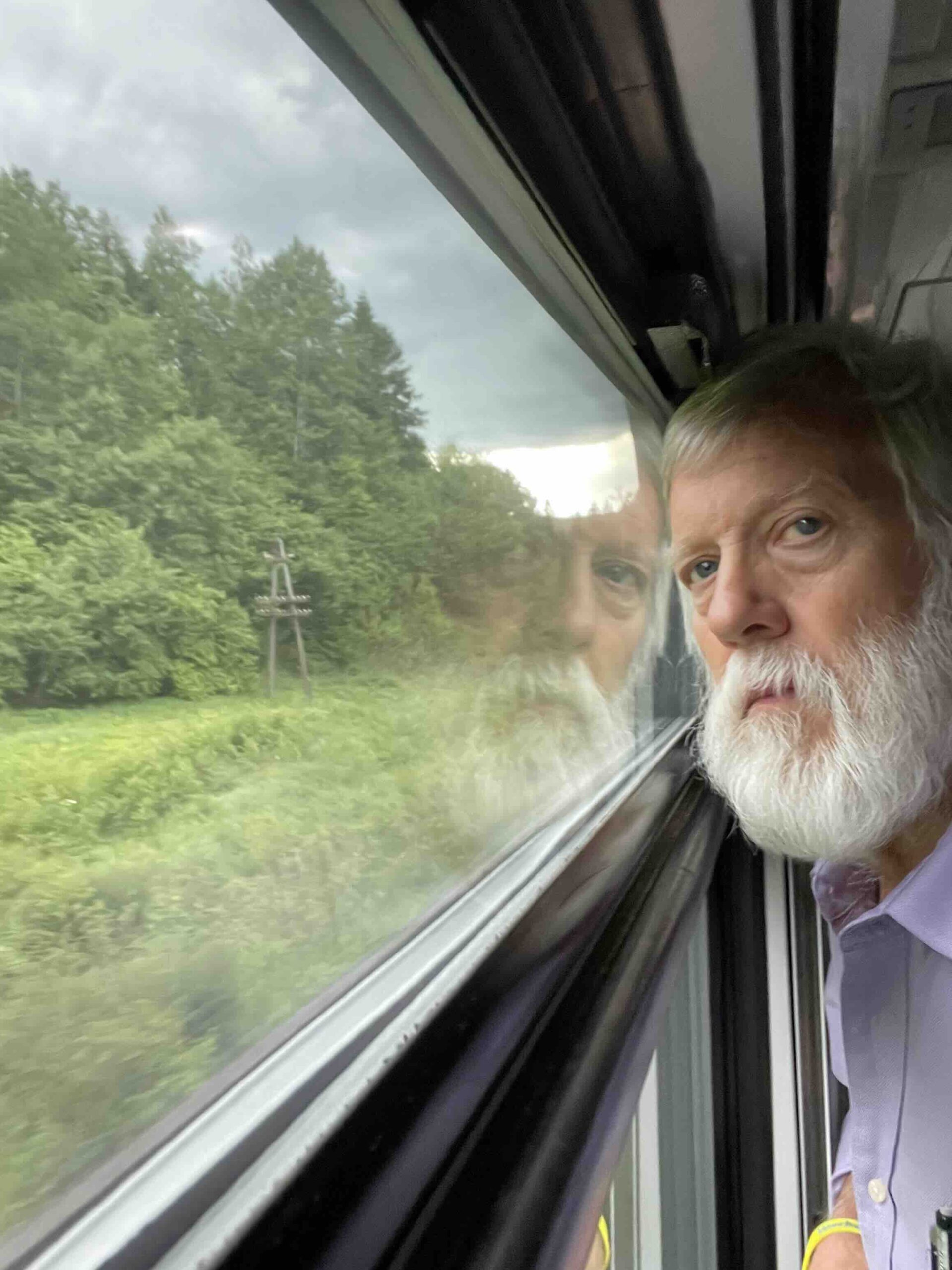
Train travel allows for adjusting to changes of culture and place
As I traveled home, some of the questions I’ve asked myself resurfaced: • “Knowing that responsibility comes with knowledge, how can I act in a way commensurate with the tremendous honor I have been given?” And also: • “What is my role to be in all this?” A third question, So why travel to a war zone? has been well answered: Opening to the fullness of the Ukrainian experience. Being present to both the pathos and the bliss of Ukraine. Bonding with people in this amazing country, not in pursuit of any particular goal, but out of human warmth and camaraderie.
And having my awareness expanded greatly, not just about this amazing place and its beautiful people, but about the critical place both Ukraine and the USA play in this historical moment. I am touched and warmed… but I am also powerfully moved to act, even as I continue to figure out what that actions might be. Sharing these stories is a starting point. Thank you for following along with me in my travels, and share your thoughts in a comment if you will!
* * * * * * * * * *
Postscript: Though my travels took place in the summer, this essay is being published in midwinter. And it’s the middle of a very difficult winter in Kyiv. As you most likely know, both Ukraine and Russia are leveraging attacks far from the actual, mostly stalemated, battlefields in Eastern Ukraine. But while Ukraine tends to attack Russian refineries and military installations, Russia is seeking to make life as difficult as possible for Ukrainian citizens, especially in Kyiv. Many power stations in the capital have been hit and as of this writing, millions of people are struggling without power or heat. As my friend Val recently wrote, under the heading of Joke of the Day: “How to avoid high expectations when communicating with Ukrainians: Start your letter with a phrase like ‘Dear ________, I hope you are alive.'” I can do little more than to acknowledge the hardships Ukrainians are facing, particularly since the US government is so immobilized by its own corruption and chaos. But I encourage you to find ways to send supportive energy, and if you’re able, money. Here are some links you might use to learn more or to send a contribution.
* * * * * * * * * *
Second postscript: To watch a one hour presentation I gave in November, with a focus on what Americans can learn from Ukrainians, the link is here.
“The many things I saw and experienced in Ukraine are not like books to be put on a shelf”.
Beautifully put. And the statue of the young girl…those are not things you can ever leave behind.
Thanks, Daniel, for sharing.
I appreciate your reflection, Dorothy. Yes, the sculpture of the starving girl has become an icon of sorts that I hold in my mind when thinking of the suffering of Ukrainians. Even though the Holodomyr was nearly 100 years ago, Russian oppression remains a key theme in the Ukrainian story. My sincere hope is that we can shift that reality in the not too distant future.
Dear Daniel,
thank you so much for your couriosity and courage that brought you to Ukraine – and for sharing your experiences with great perspective and warmth.
As always, the energy you bring is inspiring and encouraging. It is helping me to reflect what my role is in all of this.
All the best to you – also for your current work in support of US democracy and peace.
Simon, I feel that whatever curiosity and courage that I have is minimal in comparison with the resolve and strength of the Ukrainian people. But I feel honored by your comment nonetheless, especially coming from Switzerland! I’m especially grateful for you speaking about “helping me to reflect what my role is in all this.” This to me is vital — for each of us to reflect on our roles, to accept a measure of responsibility for the situation in Ukraine, and to find ways of acting upon that responsibility. I really feel (as my talk At the Edge of Democracy clearly indicates) that the key thing I can do as an American is to work toward a functioning and morally grounded democracy in my country. When we achieve that, there will be no question about fully and generously supporting Ukraine’s defense.